Anamap Blog
Cartos vs Mixpanel AI for signup and onboarding analysis
AI & Analytics
Updated 2026-11-13
Mixpanel Agent is Mixpanel’s built-in assistant for investigating how people use an app or website. Cartos is Anamap’s AI analyst for investigating questions across connected analytics tools. We wanted to see what Cartos could add for a team already using Mixpanel Agent.
We asked both assistants to track a signup cohort from form entry into onboarding and use the evidence to decide what the team should improve first.
Cartos matched Mixpanel Agent’s signup counts and explained why the stricter funnel excluded one finisher. It then proposed giving finishers one clear setup action and measuring whether they took it.
Anamap makes Cartos. We recorded the comparison on November 5, 2026, using synthetic Supastack data. The article includes the original results, the operator correction and the later check so you can judge their practical significance.
What Cartos did well
Cartos explained why requiring a submission could exclude someone who still finished signup and identified possible explanations, including a tracking gap or an event recorded out of order. A later Cartos-only check kept the original cohort and one-day window in Mixpanel when measuring whether finishers ran a query.
What Mixpanel Agent did well
Mixpanel Agent reproduced both signup counts in native reports. After we clarified the cohort and window, it delivered the stronger native onboarding answer: zero tracked starts and zero completed steps among the original finishers.
Which is better for your business and why?
Choose Cartos if you want to understand why a funnel changed and turn that finding into a test. In this run it gave the team a specific setup action to measure. Choose Mixpanel Agent when you need a native onboarding report and can verify the cohort and window. Cartos used Amplitude for that follow-up in the original run.
Results at a glance
Swipe or scroll sideways to compare both assistants.
| What the team needed | Cartos | Mixpanel Agent |
|---|---|---|
| Explain why one finisher dropped out of the stricter funnel | Identified the missing ordered step and explained how an alternate route, tracking gap, or event order could account for it. | Matched the stricter count and pointed to Session Replay, which had no recordings. |
| Choose what to test first | Give finishers one clear setup action and measure whether they take it. | Recommended investigating the onboarding handoff. |
| Verify signup completion within one day | 5 of 26 (19.2%). Requiring submission yielded 26 → 8 → 4. | Matched both counts in native Mixpanel reports. |
| Follow the original finishers into onboarding | Kept the cohort and window. Used Amplitude when the original Mixpanel follow-up stalled. | After a scope correction, reported zero tracked starts and zero completed steps in Mixpanel. |
In a later Cartos-only check, Cartos kept the same cohort, one-day window, and Mixpanel source in a single query for a specific milestone.
What we asked and why
We asked four questions in order, keeping each set of follow-ups in the same conversation:
- Opening question: “Of the people who started signup Oct 31-Nov 1, 2026, what share finished within a day?”
- “What changes if we require a form submission in between? Can we see why?”
- “Did those signup finishers complete onboarding?”
- “What should we improve first?”
We chose a signup investigation because it starts with a count the team can check and ends with a decision. Requiring a submission tests whether the assistant understands the difference between finishing signup and finishing through a specific path. Asking about “those signup finishers” tests whether it carries the original people and time window into onboarding. The recommendation shows how it uses that evidence.
How we set up and checked the test
- Same project, dates, and window. We started fresh chats in the same synthetic Mixpanel project and used signup entry dates of October 31 through November 1, Pacific time. Both tools had one elapsed day from signup start to count a conversion.
- Shared event definitions. Both products received the same descriptions of form entry, submission, and completion. We supplied no expected counts or diagnosis, and other saved context differed. Cartos’s opening prompt added “Use Mixpanel for this.”
- Reports and verification. Mixpanel Agent used native reports. The demo plan excluded Cartos from Mixpanel’s reporting API, so it computed the signup funnels using exported events from the project. We checked the counts against a frozen copy of the demo data.
- Onboarding clarification. After Mixpanel Agent changed the group and window, we added “Keep the original signup-start cohort and the same one-day window.” The recording preserves both answers. Detailed test method
Matching conversion rates were only the starting point
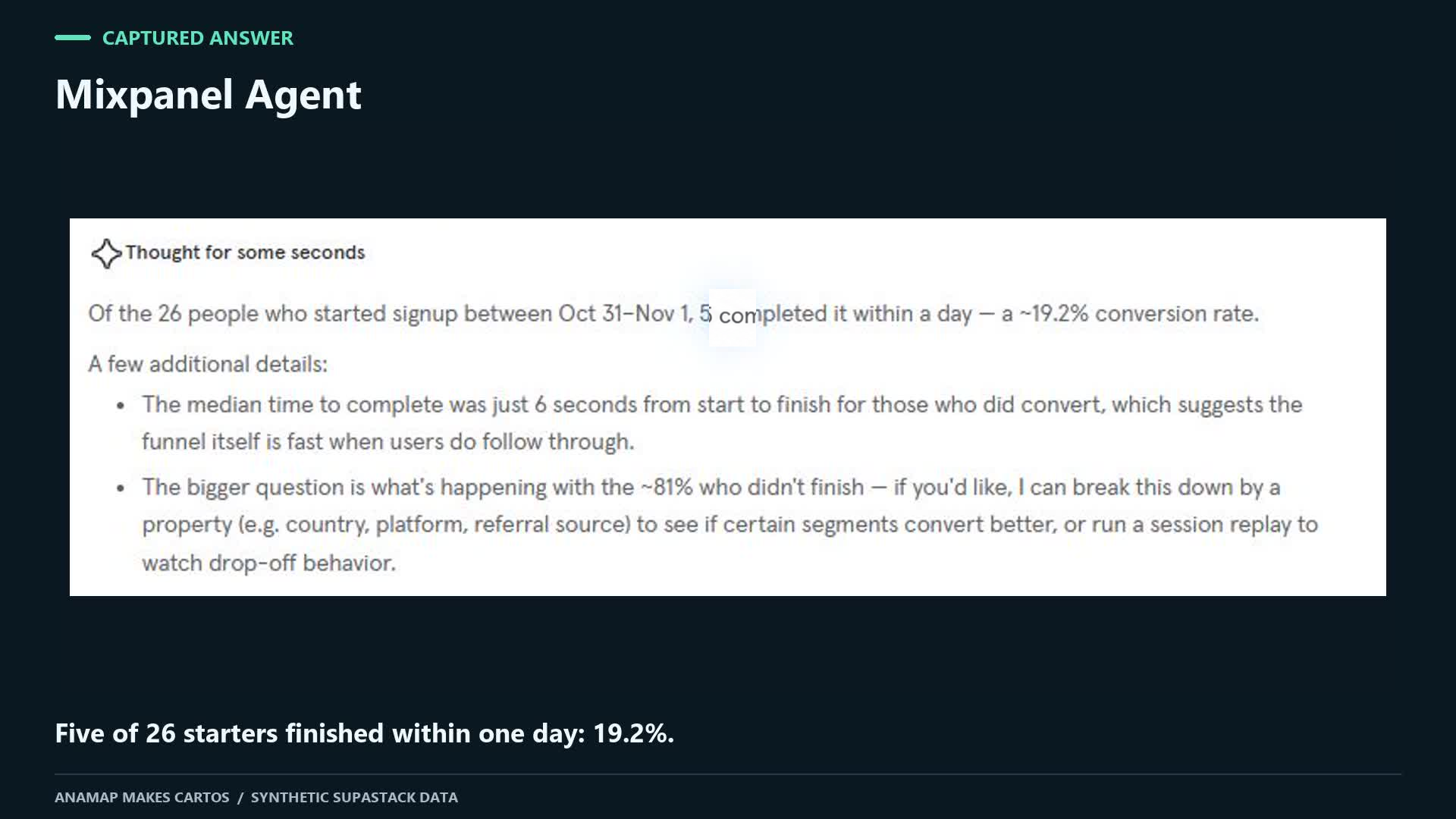
Both assistants returned 26 signup starters → 5 finishers within one day, or 19.2%. Requiring a recorded submission between start and finish returned 26 → 8 → 4, or 15.4% overall.
Cartos explained why the stricter report excluded a finisher. The report required a submission in a particular position in the recorded sequence. An alternate route, an event recorded out of order, or missing tracking could account for the difference.
That distinction changes the next task. A team can check the excluded finisher’s event sequence and verify how submission is tracked before deciding whether the form itself needs work.
Mixpanel Agent offered Session Replay as a way to investigate. The linked page had no recordings, so we reopened the same conversation. It also reported a six-second median signup time among converters. That timing described people who finished and left the behavior of those who abandoned unresolved.
The onboarding answer needed the same people and window
- Mixpanel’s first answer began with eight completion users from a wider period and allowed seven days for onboarding.
- After we restated the scope, Mixpanel reported 26 starters → 5 finishers → 0 onboarding starts → 0 completed onboarding steps in Mixpanel.
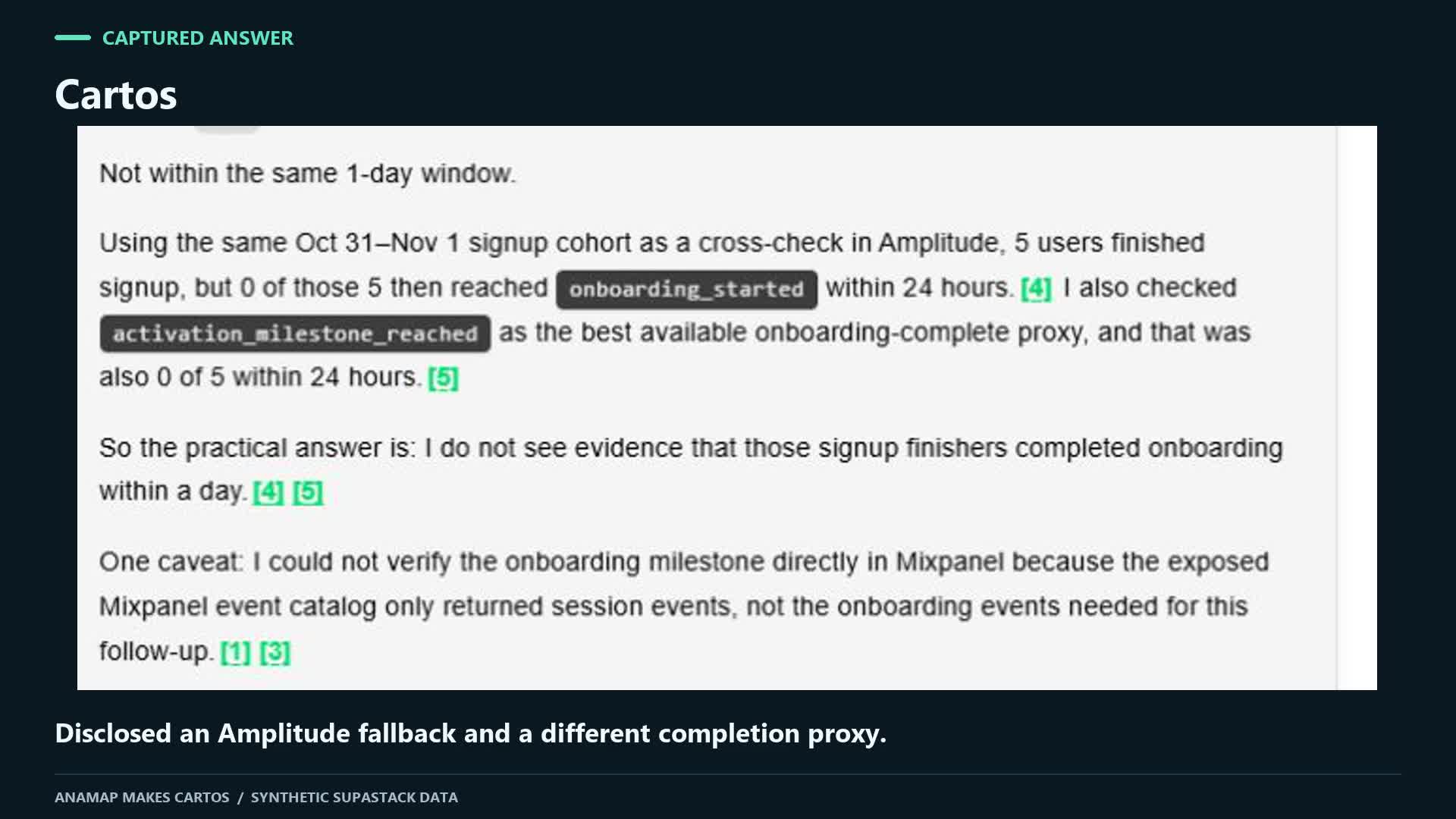
- Cartos kept the original group definition and window. After unsuccessful attempts to find the relevant Mixpanel events, it disclosed a switch to Amplitude and used activation as its closest signal for onboarding completion.
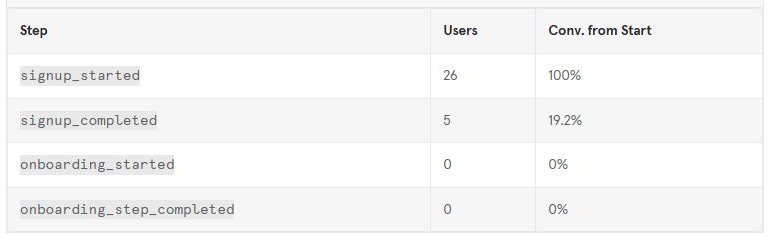
For someone who needed a Mixpanel report to take back to the team, Mixpanel’s corrected answer was the more useful outcome. Restating the user group and time window changed the question the assistant actually answered.
Cartos’s later follow-up stayed in Mixpanel
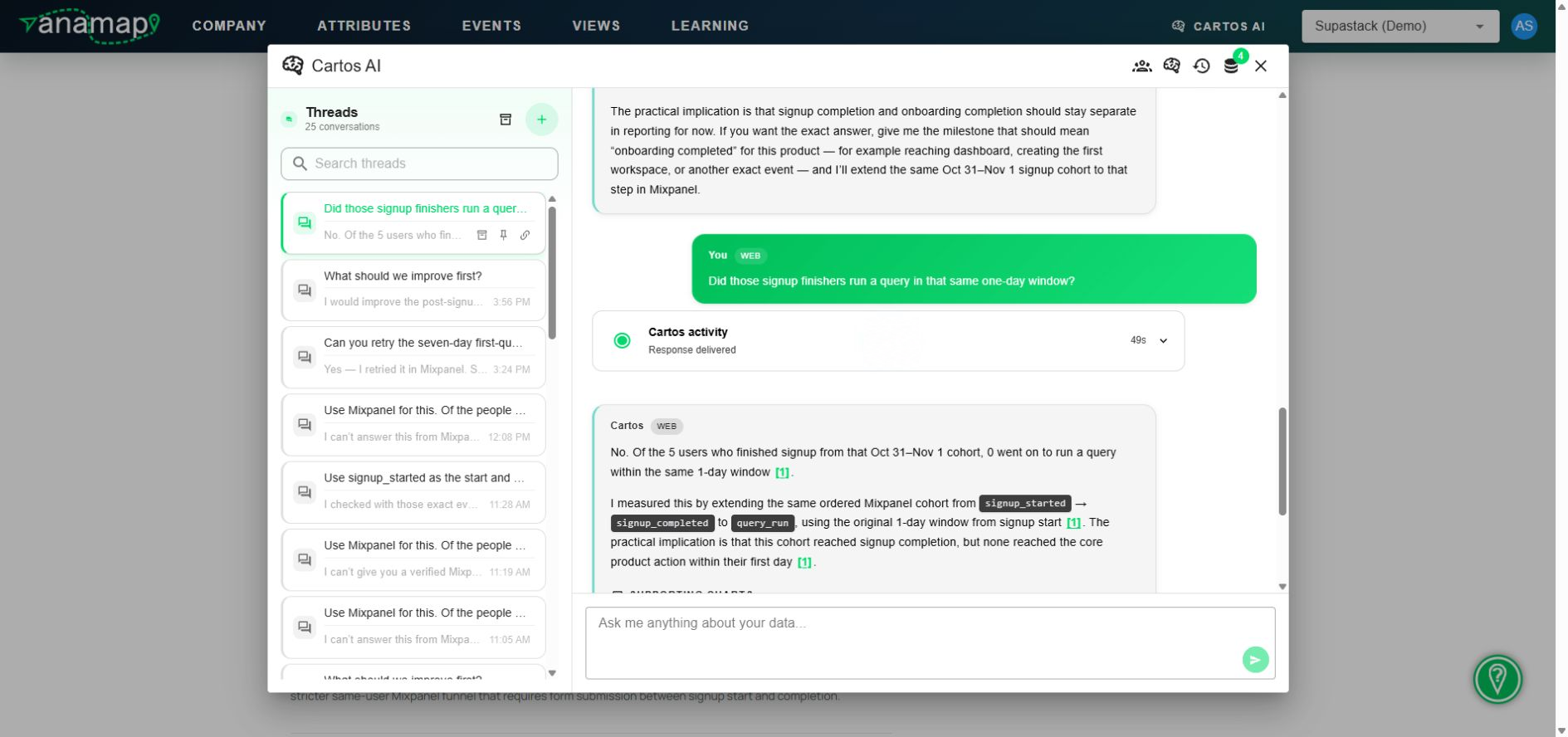
We subsequently deployed improvements to preserve the source and user group and reuse stored event definitions. We then asked Cartos whether those same signup finishers ran a query within the original one-day window.
Cartos returned 26 starters → 5 finishers → 0 query users through Mixpanel in one analytics query, with no event-discovery calls. It kept the requested source, entry dates and window for that follow-up.
That is a concrete improvement for a stakeholder trying to stay with one investigation. It reduces the work of reconciling an answer from a different analytics source.
The follow-up tested Cartos alone and used running a query as the milestone. Supastack still needs an agreed definition of onboarding completion. This later run shows how Cartos handled a specific milestone in Mixpanel. Later Cartos check
Which answer would help a team take action?
Both assistants recommended investigating the transition from signup to onboarding. Mixpanel made claims about the cause and likely effort that went beyond the evidence available in the recording.
Cartos proposed directing finishers into a clear first setup action and measuring it. That gives the team a specific experiment to consider. Its page-level details came from the configured Supastack demo fixture, so confirming the cause would still require an observed session or a reproduced issue in a real flow.
Pick one measurable first action. Ask both assistants to follow the same signup users into it. Check the analytics source, user group, and conversion window before acting on the recommendation.
Evaluate Cartos with your analytics
For other workflows, read our Amplitude AI comparison and GA4 Ask Advisor comparison.
The recording covers one investigation with a small synthetic group.