Anamap Blog
Cartos vs Amplitude AI for signup and onboarding analysis
AI & Analytics
Updated 2026-11-13
Amplitude Global Agent answers questions inside Amplitude. Cartos is Anamap’s AI analyst for investigating questions across connected analytics tools. We wanted to see what Cartos could add for a team already using Amplitude’s assistant.
We gave both assistants the same decision: should the team investigate the signup form, the handoff into onboarding, or the tracking itself?
Both assistants found that 5 of 26 people finished signup and none reached a tracked onboarding step. Cartos checked what happened in between and found one later login. That gave the team a baseline for testing the handoff into login or setup.
Anamap makes Cartos. Both runs used the same synthetic Supastack project. We recorded Global Agent on November 5, 2026, and reran Cartos on November 10 through the Amplitude Dashboard API. Amplitude blocked a fresh Global Agent chat during the retake, so the native answers come from the November 5 recording.
What Cartos did well
Cartos followed the original finishers beyond signup. Finding one later login gave it two outcomes to measure separately: whether people got back into the product and whether they took the first setup step.
What Amplitude Global Agent did well
Global Agent showed the signup counts in an inspectable native chart and broke them down by acquisition channel. It also flagged the redirect and session handoff as an area to audit.
Which is better for your business and why?
Choose Cartos if your team needs to decide what to test next. In this run it turned the handoff diagnosis into a change with a baseline and clear measures. Choose Global Agent if the immediate job is to review the native funnel and dig into acquisition channels inside Amplitude.
Results at a glance
Swipe or scroll sideways to compare both assistants.
| What the team needed | Amplitude Global Agent | Cartos |
|---|---|---|
| See what happened after signup | Found zero tracked onboarding milestones. | Found the same zero, then checked login. 1 of 5 finishers logged in later. |
| Pick a first change to test | Suggested auditing the redirect and session handoff. | Proposed sending finishers straight to login or setup. Track both actions and check that signup completion holds steady. |
| Explain the missing submission | Described starters outside the ordered submission step as form abandoners. | Spotted that one excluded user still finished signup. Flagged event order, missing tracking, and a skipped step as possibilities. |
| Verify the signup counts | 5 of 26 finished, or 4 of 26 with submission required. Showed a native chart and acquisition breakdown. | Matched both counts and showed the ordered steps. |
What we asked and why
We asked four questions in order, keeping each set of follow-ups in the same conversation:
- Opening question: “Of the people who started signup Oct 31-Nov 1, 2026, what share finished?”
- “What changes if we require a form submission in between? Can we see why?”
- “Did those signup finishers complete onboarding?”
- “What should we improve first?”
We chose a signup investigation because it moves from a number a team can check to a decision it has to make. The first question establishes the baseline. The submission question tests how the answer changes when the same people must take a specific path. The onboarding question tests whether the assistant follows the original finishers. The final question tests whether its recommendation follows from what it found.
How we set up and checked the test
- Same project and entry dates. Each assistant started in a fresh chat with the same synthetic Amplitude project. Signup entry dates were October 31 through November 1, Pacific time. We supplied no event names or expected counts. Existing project and company context remained available.
- Connection. Cartos’s opening prompt added “Use Amplitude Dashboard API for this.” That connection could query the project and access the Export API. The original Cartos run used a separate Amplitude MCP connection.
- Verification. Global Agent used a seven-day window. The recorded Cartos run used the API’s 30-day default, and a separate live seven-day check reproduced the counts. We checked event order separately against a frozen copy of the demo data. Retake evidence · Amplitude funnel settings
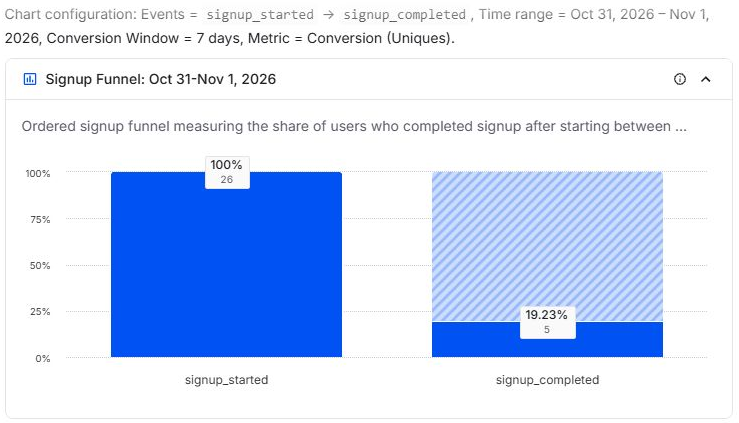
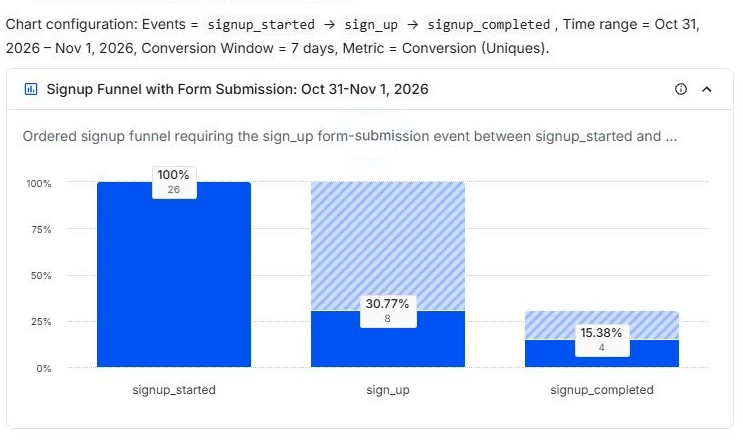
Requiring a submission changed what the funnel counted
The baseline asks whether signup starters finished. The stricter funnel also requires a submission in between. It returned 26 starters, 8 qualifying submissions, and 4 finishes (15.4%). One of the five signup finishers fell outside the stricter definition.
Global Agent called the 18 starters outside the qualifying submission step form abandoners. Cartos kept three explanations open for the excluded finisher: the person could have skipped the submission, tracking could have missed it, or the event could have been recorded out of order. The funnel alone leaves those possibilities open.
An independent replay of the frozen synthetic event data found the excluded finisher’s submission recorded before signup start. Why the timestamps appear in that order remains unresolved. Retake and replay notes
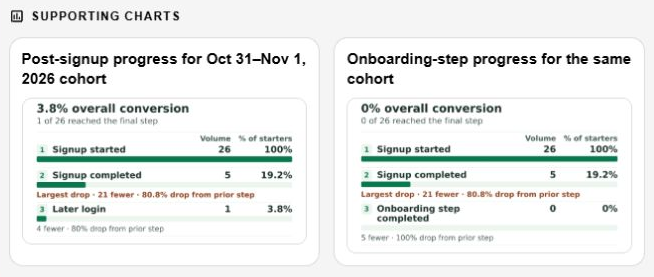
One finisher logged in, and none reached a tracked onboarding step
Both assistants found zero tracked onboarding starts, completed steps, and activations among the five signup finishers. Cartos also found that one of the five logged in later. The counts leave room for a tracking gap, a redirect or session issue, and other explanations.
Global Agent suggested auditing the redirect and session handoff, then investigating signup friction by acquisition source. Cartos turned that same priority into a test: send finishers straight to login or the first setup step. Measure later login and onboarding step completion on the next comparable cohort, and check that the signup completion rate holds steady. Measuring login and setup separately would help the team see whether a change gets more people back into the product and whether they make progress once there.
Follow one signup through the redirect. Verify that login and the first meaningful setup action are tracked. Use a larger cohort before treating a change in logins as a decision threshold.
What the Export API check showed
- During the recording. The export request succeeded and found zero uploaded rows in the two signup-date windows. The demo data was backfilled on November 2, and Amplitude’s Export API selects rows by UTC server upload time.
- After the recording. A separate check of the upload hour opened the archive and inspected 25 rows, the cap we set. That verified export access. Confirming the excluded finisher’s sequence through a live export would require linking that user’s events across the relevant windows. Amplitude Export API
Limits of the comparison
These are recorded examples from one synthetic project with five signup finishers. The two recording dates and different initial window settings limit any broader comparison.
Run a signup investigation with Cartos
We looked at the same signup and onboarding problem in our GA4 Ask Advisor comparison and Mixpanel Agent comparison.